

On January 4, 2023, the Office of Information and Regulatory Affairs released the Fall 2022 Unified Agenda of Regulatory and Deregulatory Actions, which includes, among other things, the SEC’s semi-annual regulatory agenda. The agenda outlines the SEC’s rulemaking priorities for 2023 and, as noted below, includes a potential proposal on disclosures for resource-extraction issuers and other proposals affecting capital markets more broadly.

There are 52 items on the agenda, with 23 items at proposed rulemaking stage and 29 items at the final rule stage.  Potential proposals include proposals regarding:

  • corporate board diversity disclosures;
  • human capital management disclosures;
  • amendments to Regulation D, including updates to the accredited investor definition;
  • amendments to the “held of record” definition for purposes of Section 12(g) of the Exchange Act;
  • implementation of the prohibition under Section 621 of the Dodd-Frank on material conflicts of interest in connection with certain securitizations;
  • cybersecurity risk disclosures;
  • exchange-traded products;
  • clearance of certain trades and repo transactions involving government securities; and
  • various measures affecting investment advisers and capital markets structure.

According to the agenda, the SEC’s Division of Corporation Finance (CorpFin) is considering recommending that the SEC review rules under Section 1504 of the Dodd-Frank Act to determine if additional amendments might be appropriate. The current rules require resource-extraction issuers to disclose annual payments to U.S. or foreign governments in connection with the commercial development of oil, natural gas or minerals. The current rules were adopted by the SEC in December 2020 by a 3-2 vote with the SEC’s two Republican commissioners at the time and then-serving SEC Chairman Jay Clayton voting for adoption of the rules over the dissents of the SEC’s two Democratic commissioners.

Appearing for the first time in the agenda are proposals relating to amendments to the SEC’s Rules of Practice and amendments to the SEC’s Privacy Act regulations.  CorpFin is considering recommending that the SEC propose amendments to:

  • the Rules of Practice regarding, among other things, service of SEC Orders Instituting Proceedings (OIPs) to align the service requirements governing OIPs with the service requirements that govern related actions in federal court; and
  • the Privacy Act regulations to update, clarify, and streamline the regulations to simplify the processes for submitting and receiving responses to Privacy Act inquiries, requests and administrative appeals, among other things.

In a statement release on January 4, SEC Chairman Gary Gensler said, “The SEC’s regulatory actions on this unified agenda would help make our markets more efficient, resilient, and fair, including through rulemaking items we have been directed by Congress to implement.  Taken together, the items on this agenda would advance our three-part mission: to protect investors, maintain fair, orderly, and efficient markets, and facilitate capital formation.”

The Fall 2022 Unified Agenda of Regulatory and Deregulatory Actions may be viewed here, and Chair Gensler’s statement may be viewed here.
On December 27, 2022, the US Treasury Department and the Internal Revenue Service (“IRS”) issued Notice 2023-2 (the “Notice”), which provides taxpayers interim guidance (until regulations are issued) on how the new 1% excise tax on stock-buybacks will be imposed and administered. The new 1% excise tax was enacted last summer as part of the Inflation Reduction Act of 2022 and generally applies to any US corporation whose stock is traded on an established securities market and that repurchases more than $1 million of stock over the course of a tax year. Taxpayers may rely on the Notice pending the issuance of proposed regulations. 

This Legal Update discusses the Notice’s clarification of “repurchases”; how acquisitions of certain foreign corporation stock will be treated; timing, fair market value and the qualifying property exception; the netting rule; reporting; examples provided of transactions that may or may not be subject to the stock repurchase excise tax; and specific areas on which comments are being solicited.

Read the complete Legal Update.

On December 15, 2022, the New York Stock Exchange (“NYSE”) received approval from the Securities and Exchange Commission (“SEC”) to modify certain pricing limitations for companies undertaking a direct listing involving sales of company shares in the opening auction on the first day of trading on the NYSE.  The approval and related conditions are consistent with the approval granted by the SEC to Nasdaq earlier this month, as previously blogged

The rule change provides that a direct listing with a primary offering may proceed, so long as (i) the actual price is set at or above the price that is 20% below the lowest price within the disclosed price range or (ii) the actual price is set at or below the price that is 80% above the highest price of the disclosed price range.  In order to rely on the additional pricing flexibility, the company is required to publicly disclose and certify to the NYSE that the company does not expect such price would materially change the company’s previous disclosure in its effective registration statement and that its effective registration statement contains a sensitivity analysis explaining how the company’s plans would change if the actual offering proceeds are less than or exceed those that would be raised if the offering were to proceed at a price within the disclosed price range. 

As part of the rule change, the NYSE also requires that the company retain an underwriter with respect to the primary sales of shares and identify the underwriter in its effective registration statement.  While the requirement to include an underwriter mitigated the SEC’s concerns relating to traceability and the perceived lack of a “gatekeeper” that often arise, the perception of increased securities liability for the identified underwriter will likely increase the costs associated with conducting a direct listing with a capital raise and potentially diminish the likelihood this alternative to a traditional IPO will be pursued.

A link to the SEC’s approval can be found here.

January 19, 2023 Webinar

12:00 pm – 1:00 pm ET

Register here.

In December 2022, the Securities and Exchange Commission adopted significant amendments to Rule 10b5-1, which provides, under certain conditions, an affirmative defense to insider trading claims. Issuers and their boards or directors, large stockholders and investment banks that administer trading plans should prepare now to comply with the amendments. During our session, Mayer Brown Panelists Jennifer Carlson, Anna Pinedo, Laura Richman, and David Schuette will discuss:

  • Principal changes between the proposed amendments and the final amendments; 
  • The required cooling off periods and exceptions; 
  • Issuer insider trading policies and filing requirements; 
  • Issuer disclosure requirements;
  • Other issuer considerations; 
  • Compensation committee considerations; 
  • Section 16 reporting requirements; 
  • Considerations for investment banks; and 
  • Effective dates and transition issues.

January 20, 2023 Webinar

12:00 pm – 1:00 pm ET

Register here.

2022 was a year marked by the market’s increasing preference for structured financing alternatives. During this session, panelists Syed Raj Imteaz and Anna Shearer of ICR Capital joined by Mayer Brown’s Anna Pinedo will discuss market trends within the structured debt and private convertibles sector, as well as issues to consider from a legal perspective.

Topics will cover: 

  • The building blocks of a convertible;
  • Differences between a private convertible and a public convertible, as well as benefits and drawbacks of each;
  • Structuring toggles;
  • Various types of investors;
  • Variations of pre-IPO convertibles;
  • Converting pre-IPO convertibles to 144A convertibles upon an IPO, and the legal and practical considerations; and
  • Structured debt with warrant transactions for private companies.

January 11, 2023 Webinar

3:00 pm – 4:00 pm ET

Register here.

The Securities and Exchange Commission recently approved amendments to Rule 10b5-1 under the Securities Exchange Act of 1934, as amended (“Exchange Act”). The SEC had proposed extensive amendments in January 2022, which were the subject of significant comments from market participants. Rule 10b5-1 provides an affirmative defense to insider trading liability under Section 10(b) of the Exchange Act and Rule 10b-5 subject to certain conditions. The final amendments, which are the first since the rule’s adoption in 2000, represent a significant change for issuers, directors, officers, and other security holders. During this session hosted by the Practising Law Institute, Lawrence Cunningham, founder of Quality Shareholders Group, and Mayer Brown partner, John Ablan, will address:

  • An overview of Rule 10b5-1 and the affirmative defense and conditions
  • Concerns which prompted the amendments
  • The cooling off period requirement for directors, officers, and other parties
  • Additional representations and the good-faith requirement
  • Limitations on trading plans
  • Issuer disclosure requirements and issuer policies and procedures
  • Beneficial ownership reporting

Earlier this month, the European Commission proposed wide-ranging measures designed to facilitate further development of the EU’s capital markets, including through a new Listing Act; by making EU clearing services more attractive and resilient; and by harmonizing certain corporate insolvency rules across the EU.

Following the firm’s webcast on these proposals, we are sharing with you:

Please contact Dr. Patrick Scholl with any questions.

On December 15, 2022, the New York Department of Financial Services (“NYDFS”) issued guidance clarifying that all New York banking organizations are required to obtain prior agency approval for virtual currency-related activity (“2022 Guidance”). The 2022 Guidance is similar to prior notice guidance issued by the federal banking regulators but establishes highly prescriptive information requirements for submissions. Additionally, it greatly expands prior NYDFS guidance regarding when prior approval is required for a banking activity.

The 2022 Guidance is immediately effective for all New York banking organizations, which includes banks and trust companies that are chartered under New York banking law, as well as US branches and agencies of non-US banking organizations that are licensed under New York banking law. In this Legal Update, we provide background on the authorized activities of New York banking organizations and describe the 2022 Guidance.

Read the complete Legal Update.

On December 16, 2022, the Board of Governors of the Federal Reserve System adopted final rule 12 C.F.R. Part 253, “Regulation Implementing the Adjustable Interest Rate (LIBOR) Act (Regulation ZZ)” (“Rule 253” or the “Final Rule”). Rule 253 identifies SOFR-based benchmark rates that will replace U.S. dollar LIBOR in certain financial contracts after June 30, 2023. Rule 253 will become effective 30 days after its publication in the Federal Register. 

The Final Rule responds to several rulemaking requirements of the Adjustable Interest Rate (LIBOR) Act (“AIRLA”), and resolves some remaining questions about how outstanding USD LIBOR contracts will transition to a replacement rate after USD LIBOR ceases publication.  

Read the complete Legal Update.

The Securities and Exchange Commission’s Office of the Advocate for Small Business Capital Formation issued on December 16, 2022 its 2022 Annual Report to the U.S. Congress and to the SEC detailing how entrepreneurs, investors, and private and smaller public companies are engaging in capital raising.  The Report provides a wealth of data from the SEC’s Division of Economic and Risk Analysis (DERA) and other sources.

Based on DERA data, from July 1, 2021 to June 30, 2022, for example, companies raised $1.1 trillion in SEC registered offerings (and $126 billion in IPOs), and $2.3 trillion in Rule 506(b) private placements and $2.0 trillion in other exempt offerings.  Companies raised $148 billion in Rule 506(c) offerings, $624 million in Rule 504 offerings, $1.8 billion in Regulation A offerings and $368 million in crowdfunding.  The Report provides interesting data on the capital raising methodology relied upon by companies in different sectors, as well as a geographic analysis of where companies are raising capital (by state) within the United States.  Pooled fund account for over 85% of the funds raised under Regulation D.  Excluding pooled funds, technology companies rely most on raising capital through Regulation D offerings.  The amounts sought to be raised by companies undertaking Regulation A offerings has declined (despite the rules now allowing companies to raise more capital in reliance on Regulation A).  Real estate companies are the most frequent users of Regulation A.  The Report also addresses early stage funding—noting that in recent years, the number of seed rounds and seed firms have increased.  The Report also contains a detailed review of VC activity. 

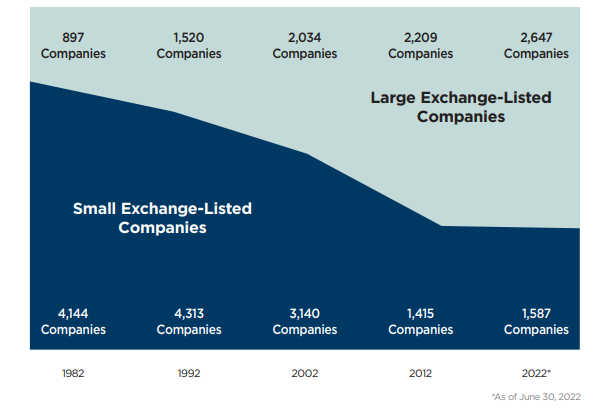
Finally, the Report examines trends affecting small public companies.  The number of small, exchange-listed companies has declined drastically, as shown in this image from the Report.

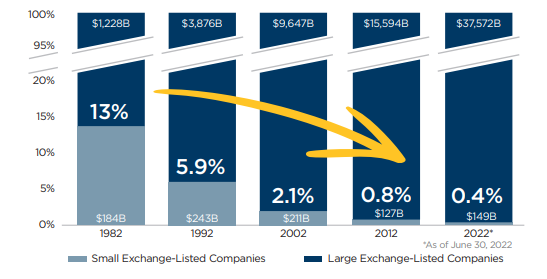
In addition, the aggregate market capitalization of small, exchange-listed companies has declined significantly, as illustrated by the image below.

This is also evidenced in reviewing IPO trends.  There are very few smaller companies undertaking IPOs.  The Report demonstrates that compliance costs generally are fixed and not scalable and have disproportionally increased for smaller reporting companies.

In addition, as the Report demonstrates, most smaller public companies do not benefit from one of the more important aspects associated with being public—research analyst coverage.  On average, small public companies are only covered by two analyst firms, compared to an average of nine for large public companies.  This directly affects liquidity in their stocks.  Small public companies with limited research coverage have lower levels of institutional ownership.  The Report indicates that only 47% of small public companies have institutional investor holdings, compared to 66% for large public company peers.  All of this suggests that, if the United States would like to preserve smaller public companies, it ought to review the regulatory scheme and market environment affecting these companies.

See the press release and the Report for much more.