On August 6, 2025, the Staff of the Division of Trading and Markets of the Securities and Exchange Commission (SEC) released an updated set of Frequently Asked Questions (FAQs) addressing the application of Rule 15c3-3a to cleared US Treasury securities.  While these responses reflect only staff views and are not an SEC rulemaking, they provide interpretive guidance for broker-dealers navigating the evolving Treasury market clearing framework.

In November 2024, the SEC approved a Fixed Income Clearing Corporation (FICC) rule change aligning its Government Securities Division (GSD) Rulebook with the requirements of Note H to Rule 15c3-3a.  Shortly thereafter, the SEC published a notice authorizing broker-dealers to include a debit in their customer reserve formula when posting cash, Treasuries, and/or qualified customer securities to FICC to satisfy customer margin obligations.  The August 2025 FAQs build on that framework.  Read the full FAQs on the SEC’s website.  A summary follows below.  

  • Notice pursuant to Rule 15c3-3a, Note H(b)(3) Regarding Application of the Reserve Formulas with Respect to Cleared U.S. Treasury Securities.  The SEC approved a rule change by the FICC in late 2024, aligning FICC-GSD’s rulebook with Rule 15c3-3a Note H.  This allows broker-dealers to include a debit in the customer and/or PAB reserve formula when depositing cash, Treasuries and/or qualified customer securities to meet margin requirements resulting from Treasury positions of customers.  See Question 1.
  • Credits in Customer Reserve Formula Related to Item 15 Debit.  Customer cash used to meet margin requirements must be included as a credit in Item 1 of the reserve formula.  The market value of customers’ securities deposited at a qualified clearing agency must be included as a credit in Item 2.  See Question 2.
  • Prefunding Customer Margin Requirements with Cash or U.S. Treasury Securities Owned by the Broker-Dealer.  Broker-dealers may use their own cash or Treasuries to meet margin requirements resulting a customer’s Treasury positions, provided conditions of Note H(b)(1)(iii)(A) through (C) are met.  On Day 1 of prefunding a customer margin requirement, a broker-dealer may  include an Item 15 debit in the customer reserve formula for the amount of the margin requirement without a corresponding credit, if (i) the broker-dealer has delivered cash/Treasuries to temporarily prefund the margin requirement and calls for margin from the customer under the conditions of Note H(b)(1)(iii)(A) and (B), respectively, and (ii) the customer has not yet provided collateral to the broker-dealer under Note H(b)(1)(iii)(C), which requires that a sufficient amount of collateral to meet the margin requirement be received by the close of the next business day after the margin requirement arose (i.e., Day 2).  See Question 3 and Question 4.
  • Use of Customers’ Securities to Meet a Margin Requirement.  Broker-dealers can post a customer’s securities that would otherwise need to be treated as fully paid or excess margin securities to meet that customer’s margin requirement, consistent with Note H.  See Question 5.
  • Excess Margin Collateral.  Excess margin collateral cannot be included as an Item 15 debit (which is limited to margin required and on deposit). Firms are incentivized to retrieve excess collateral promptly, since excess margin remains a credit with no offsetting debit if the excess margin amount is no longer required by the clearing agency. See Question 6.
  • Mark-to-Market or Variation Margin Payments.  Cash delivered by a customer to a broker -dealer for mark-to-market or variation margin payments need not be considered a credit item since the broker-dealer is not required to return these payments to the customer. However, any cash in excess of a mark-to-market or variation margin amount that a broker-dealer owes to a customer must be included in the reserve formula. See Question 7.
  • Customers Borrowing Against Other Customer Collateral to Meet a Margin Requirement of a Qualified Clearing Agency.  A broker-dealer may extend credit to a customer in the form of cash collateralized by margin securities in the customer’s account to fund the customer’s margin requirement at a qualified clearing agency. Both an Item 15 debit and an Item 10 debit may be recognized in the reserve formula, as applicable, for these two separate transactions if the conditions of Note H and other requirements of Rule 15c3-3a are satisfied. See Question 8.
  • PAB Account Holders and the PAB Reserve Formula.  The guidance applies equally to PAB account holders and PAB reserve computations. See Question 9.

Generative artificial intelligence (AI) is reshaping the financial services sector, moving from pilot projects into scaled enterprise adoption.  CB Insights’ latest report addresses 100 actual applications of generative Al in financial services and insurance (the “Report”).  According to the Report, banks, insurers, and wealth managers are deploying large language models (LLMs) in order to improve efficiency, personalize client interactions, and enhance risk management. 

Source: CB Insights

Financial institutions are focusing on practical deployments.  The Report identifies three trends: (i) embedding generative AI in front-office workflows, such as customer service and digital engagement; (ii) streamlining middle- and back-office operations, including compliance monitoring and documentation; and (iii) deploying AI-driven analytics for investment, credit, and underwriting decisions.

Banks are investing in generative AI-powered virtual assistants to handle routine client inquiries, freeing relationship managers to focus on higher-value interactions.  Some banks have deployed LLMs to accelerate onboarding and loan documentation, reducing turnaround times significantly.  The Report cites examples of several large banks that have:

  • One launched an AI-driven contract intelligence system to accelerate loan documentation.
  • Another is piloting generative AI in trade surveillance, automating monitoring for anomalies.
  • Finally, a third deployed virtual assistants to manage retail customer queries, reducing call-center volumes.

Insurers are applying generative AI to claims management and underwriting.  By automating claims documentation and fraud detection, companies report both cost savings and reduced cycle times. The Report provides specific examples of:  an insurer that has rolled out AI-powered chatbots for policy servicing and claims updates; another that is testing generative AI to personalize policy recommendations for small business clients; and another that is using AI in claims triage, integrating generative models to process unstructured customer statements.

In wealth management, generative AI is enabling hyper-personalized advice.  Asset managers are deploying AI copilots to assist advisors in tailoring recommendations, generating portfolio summaries, and monitoring client goals.  Examples cited include asset managers experimenting with LLMs to synthesize market research and generate client-ready insights; a fund complex that has deployed advisor copilots that generate personalized portfolio summaries for client reviews; and a financial services enterprise that is piloting AI chat interfaces in its digital brokerage platform to guide investor decision-making.

While adoption is increasing, risks remain. CB Insights emphasizes model hallucinations, data security, and regulatory scrutiny as top challenges.  Institutions are investing in “AI governance” frameworks, focusing on auditability, explainability, and compliance with emerging regulations.  The Report notes some institutions have built internal “AI governance committees” to review model accuracy and compliance, and provides examples of other safeguards being implemented to mitigate risk.

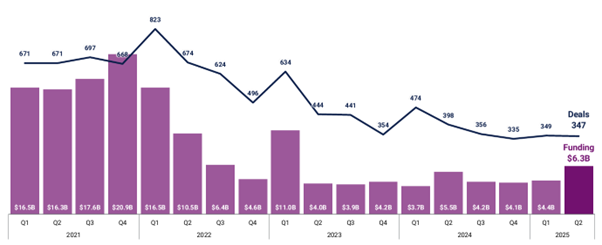
Global fintech funding reached $10.5 billion in the second quarter of 2025, marking the second consecutive quarter above $10 billion, a first since early 2023.  In aggregate, fintech companies raised $21.2 billion in the first half of 2025.  Deal volume fell to 804 in the second quarter, continuing the multi-year slowdown from 2021 highs.  US-based fintech companies captured a record share of both deals (43%) and mega-rounds (65%), with US funding accounting for 60% of global fintech investment in Q2.  In the first half of 2025, fintech companies completed 696 deals raising an aggregate of $10.7 billion.

US Quarterly Fintech Funding

Source: CBInsights State of Fintech Report Q2 2025

Late-stage deals.  Investor caution persists, but late-stage companies maintained meaningful activity. Late-stage rounds represented 10% of global deal share year-to-date, with the US capturing the majority of the largest transactions.  Median late-stage deal size reached $45 million, up from $30 million in 2024.  Notable Q2 deals include Ramp’s $200 million Series D and Persona’s $200 million Series D, both US-based.

Mega rounds and unicorns.  Mega-round activity totaled $4.2 billion in 16 deals, with the US capturing 70% of funding–including Plaid’s $575 million venture round and Rippling’s $450 million Series G. There were three new fintech unicorns in Q2 (Kalshi, Chapter, and Juniper Square) bringing the total to 325, of which 173 are US-based.  Stripe remains the highest-valued fintech at $70 billion.

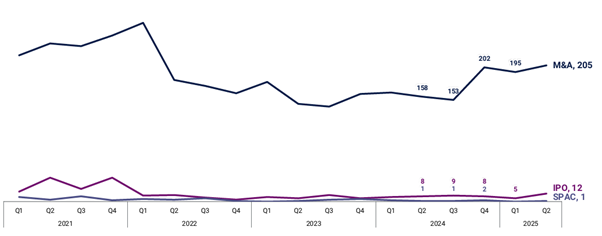
Exits.  Fintech M&A volume remained elevated, with 205 transactions in Q2.  Digital asset deals featured prominently, including Coinbase’s $2.9 billion acquisition of Deribit and Stripe’s acquisition of Privy.  IPO activity picked up, led by Chime’s $9.8 billion debut and Circle’s $6.9 billion IPO. There was one SPAC transaction completed by Webull, valued at $7.3 billion.

Global Quarterly Fintech Exits

Source: CBInsights State of Fintech Report Q2 2025

Fintech Subsector Funding

Payments companies raised $2.9 billion in 127 deals, with the US leading at $1.3 billion.  Plaid, Ramp, and Dojo topped the list, with B2B players capturing 60% of the largest payments investments.  Digital lending funding reached $1.8 billion in 118 deals.  The US accounted for $1.1 billion, led by Plaid’s round and Dunmor’s $150 million raise.  Insurtech companies secured $1.1 billion in 89 deals. The largest were Gravie’s $144 million Series G and Bestow’s $120 million Series D financings.  Wealth tech surged to $1.9 billion in funding, nearly triple the Q1 total and the sector’s strongest quarter since 2022.  Addepar’s $230 million Series G and Groww’s $200 million Series F were the largest.

Read CBInsight’s full report for additional trends and data.

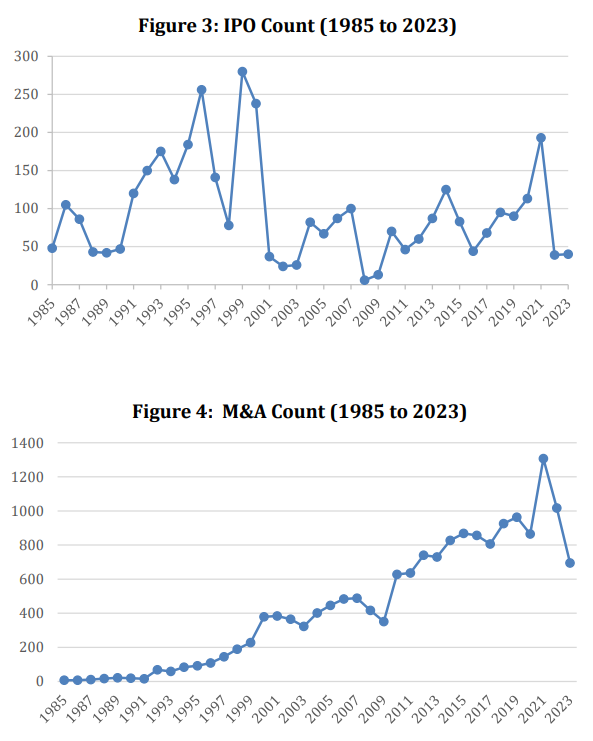
In No Exit, a recent paper, authors Brian J. Broughman, Matthew T. Wansley, and Samuel N. Weistein, describe how increased antitrust restrictions caused a decline in M&A exits by startups.  However, instead of this leading to an increase in IPOs, companies remained private and used alternatives to access capital and liquidity.

Source: Broughman, Wansley, Weistein

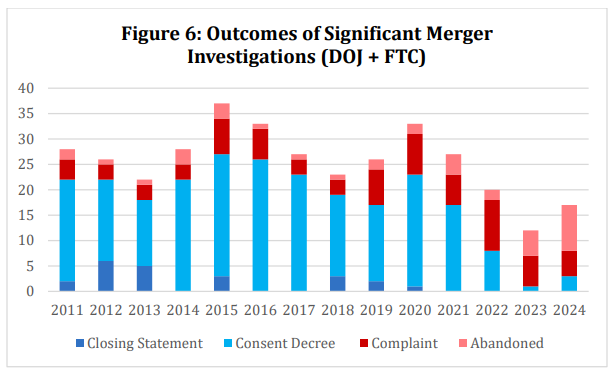
Under the Biden administration antitrust policy changed, with increased enforcement and changes to the merger review policy, among other changes. While these changes applied to all mergers, they had a stronger impact on venture-backed startups because these relate largely to technology companies and also previously experienced low levels of enforcement.  

Source: Broughman, Wansley, Weistein

The authors note IPOs are not a perfect substitute for M&A exits because economies of scale and scope, synergies, regulatory costs, market power, and market cyclicity can lead to IPO valuations being below M&A prices. As a result, in response to these antitrust changes, startups chose not to exit. To raise more capital and liquidity privately, the authors point to two trends that became more significant: employee tender offers and continuation funds. Continuation funds allow VCs to invest in their portfolio companies longer, delaying the need for exits. Two new structures emerged, centaurs and reverse acquihires. Centaurs are private companies that are funded primarily by public cash flow, a prominent example is OpenAI, which raised $13 billion from Microsoft and Anthropic which raised $8 billion from Amazon and $3 billion from Google. Reverse acquihires are when typically a large technology company convinces the founders and key employees of a startup to quit and hires them. It then makes a payment to the startup company shell which is a fee to license the startup’s technology. An example of this is Inflection AI’s employees move to Microsoft in March 2024.

In light of the domino effect of antitrust policies on the capital markets, the authors argue that policymakers should think more broadly about the effects of their actions. Given the growth of the private markets, and developments like continuation funds that extend the life of VC investments, exits will continue to be put off. See the full paper here.

On August 7, 2025, the White House issued an executive order intended to expand access to alternative assets through retirement plan vehicles.  The initiative reflects a broader regulatory shift toward facilitating retail investor participation in private markets.

The executive order directs the Secretary of Labor to reexamine and clarify existing Department of Labor guidance concerning fiduciary obligations related to the inclusion of alternative assets in ERISA-governed defined contribution plans.  This includes guidance on the appropriate fiduciary process for asset allocation funds that hold such investments.  In addition, the order calls for interagency coordination—among the Treasury Department, the Securities and Exchange Commission (”SEC”) and other regulators—to evaluate whether complementary regulatory changes are appropriate.  The SEC is also directed to revise its rules and guidance to improve access to alternative assets for participant-directed retirement plans.

As noted in our prior post on the growing use of permanent capital vehicles, sponsors have increasingly turned to these structures to provide long-term exposure to illiquid assets such as private equity and private credit.  The executive order is expected to accelerate this trend by encouraging development of fund vehicles tailored to retail investors who have historically been excluded from these asset classes.  Visit our permanent capital vehicles resources page for detailed information on these.

If regulations are implemented as described, the order could mark the beginning of a significant shift in how defined contribution plans allocate capital, reduce barriers to investment in private equity and alternative strategies and result in new retail-focused permanent capital structures.  While alternative assets may offer diversification and enhanced return potential, investors and their fiduciaries must continue to consider and assess risks associated with a vehicle’s liquidity, valuation, transparency and fees.  A link to the fact sheet discussing the Executive Order can be found here.

On August 5, 2025, the staff (the “Staff”) of the Division of Corporation Finance (the “Division”) issued new guidance regarding certain Protocol Staking (defined below) activities.  This guidance builds on a May 2025 Staff statement covering certain other types of Protocol Staking, discussed here.  Both statements provide the Staff’s views on the staking of certain crypto assets (the “Covered Crypto Assets”) that are intrinsically linked to the programmatic functioning of public, permissionless networks that use proof-of-stake as a consensus mechanism (“PoS Networks”).  Covered Crypto Assets are (1) used to participate in and/or earned for participating in a PoS network’s consensus mechanism or (2) used to maintain and/or earned for maintaining the technological operation and security of the PoS network (these activities are collectively referred to as “Protocol Staking”).  The May 2025 Staff statement addressed three types of Protocol Staking: self (or solo) staking, self-custodial staking with a third party, and custodial staking; the current Staff statement addresses “liquid staking.”

What is Liquid Staking?

Liquid staking is a type of Protocol Staking in which an owner of Covered Crypto Assets deposits the Assets with a third-party Protocol Staking service provider (the owner is referred to as a “Depositor”) in return for newly “minted” crypto assets (“Staking Receipt Tokens”), issued on a one-for-one basis with the deposited Covered Crypto Assets, that evidence the Depositor’s ownership of the deposited Assets and any related rewards.  Importantly, a Staking Receipt Token is, just as the name suggests, a “receipt” for the deposited Covered Crypto Assets.  A Staking Receipt Token can be used to provide liquidity for holders without needing to withdraw the deposited Assets from staking.   

A “Liquid Staking Provider” helps the Depositor to stake the deposited Covered Crypto Assets in return for a “fee that reduces the amount of rewards that would otherwise accrue to the deposited Covered Crypto Assets.”  The Liquid Staking Provider retains control of the Covered Crypto Assets at all times, while the Depositor retains ownership of the Assets.  There are two types of Liquid Staking Providers.  Protocol-based liquid staking providers perform all of the steps of the above process—the deposit of Covered Crypto Activities into a protocol by the Depositor, the staking of the Assets, and the minting and issuance of Staking Receipt Tokens to the Depositors—through self-executing computer code.  In the alternative, third-party liquid staking providers perform the steps outlined above. 

As with other types of Protocol Staking, in liquid staking, rewards can accrue to, and slashing losses can be deducted from, staked Covered Crypto Assets.  Specifically, either (i) a Staking Receipt Token itself evidences the rewards and slashing losses, such that the ratio between the Staking Receipt Token and the Covered Crypto Assets varies, or (ii) holders of Staking Receipt Tokens receive additional Staking Receipt Tokens in connection with rewards and lose Staking Receipt Tokens in connection with slashing losses, so the one-to-one ratio remains constant.  Rewards include newly created Covered Crypto Assets or a percentage of transaction fees, paid in Covered Crypto Assets.

Analysis of Liquid Staking Activities

The Staff’s view is that “Liquid Staking Activities,” just like the other types of Protocol Staking the Staff recently addressed, do not involve the offer and sale of securities within the meaning of Section 2(a)(1) of the Securities Act of 1933 (the “Securities Act”) or Section 3(a)(10) of the Securities Exchange Act of 1934 (the “Exchange Act”).  Therefore, participants in these activities do not need to register these transactions under the Securities Act or fall within one of the Securities Act’s exemptions from registration.  This view is limited to the following “Liquid Staking Activities”:

  • the activities discussed above that are undertaken by Liquid Staking Providers in connection with liquid staking, including activities in connection with earning and distributing rewards; slashing losses; and the minting, issuing and redeeming of Staking Receipt Tokens, such as holding deposited Covered Crypto Assets, issuing Staking Receipt Tokens, and facilitating the staking of the deposited Assets; and
  • providing Ancillary Services.[1]

Repeating from other recent Staff guidance, the Staff noted that a Covered Crypto Asset is not a type of security specifically enumerated in either the Securities Act or the Exchange Act.  Therefore, the Staff analyzed transactions involving Covered Crypto Assets in the context of Liquid Staking Activities under the “investment contract” test delineated by SEC v. W.J. Howey Co.[2]  Using the Howey test, as further interpreted by the federal courts, the Staff analyzed the economic realities of Liquid Staking Activities by considering whether there is an investment of money in a common enterprise based on a reasonable expectation of profits to be derived from the entrepreneurial or managerial efforts of others.[3]

In the Staff’s view, a Liquid Staking Provider does not provide “entrepreneurial or managerial efforts,” and instead simply acts as an agent in connection with staking the Covered Crypto Assets on behalf of the Depositor.  The Liquid Staking Provider does not make decisions with regard to the quantity of Assets to stake or otherwise, and does not guarantee any rewards to the Depositor.[4]  Even when Liquid Service Providers also provide Ancillary Services, such Services are “merely administrative or ministerial in nature,” rather than managerial.  In other words, the Howey test is not satisfied with regard to such Liquid Staking Activities.

Analysis of Staking Receipt Tokens

The Staff similarly concludes that the offer and sale of Staking Receipt Tokens does not involve the offer and sale of securities within the meaning of Section 2(a)(1) of the Securities Act or Section 3(a)(10) of the Exchange Act, such that Liquid Staking Providers involved in the process of minting, issuing and redeeming Staking Receipt Tokens, and those involved in secondary market transactions, do not need to register the transactions under the Securities Act or fall within one of the Securities Act’s exemptions from registration.[5]

A Staking Receipt Token is not specifically included in the definition of “security.”  However, the definition of “security” includes “receipt for” any security, and, as previously stated, a Staking Receipt Token is a receipt that evidences the holder’s ownership of the deposited Covered Crypto Asset.  That said, the Staff concludes that, because a Covered Crypto Asset is not a security, a Staking Receipt Token also cannot be a security.

In addition, the Staff considered whether a Staking Receipt Token is “offered and sold as part of or subject to an investment contract” under the Howey test, and answers this question in the negative.  Specifically, the parties involved in minting, issuing and redeeming Staking Receipt Tokens do not provide entrepreneurial or managerial efforts to Staked Receipt Token holders.  Any value realized by such holders is derived from the value of the deposited Covered Crypto Assets themselves, including the value of rewards, rather than from the entrepreneurial or managerial efforts of the Liquid Staking Provider or any other third party, and, therefore, the Howey test is not met.

Commissioner Responses

As we have become accustomed to seeing, Commissioners Peirce and Crenshaw both responded to the Staff statement.  Commissioner Peirce voiced her support for the Staff’s position on Liquid Staking Activities, analogizing to the transfer of fungible goods, such as “gold bars or cereal grains,” in return for a receipt, which “simplif[ies] transaction settlement and unlock[s] greater liquidity for those goods.” In other words, Liquid Staking Activities are “a variant on the longstanding practice of depositing goods with an agent who performs a ministerial function in exchange for a receipt that evidences ownership of the goods.”

Commissioner Crenshaw repeated her critique of other related Staff guidance, namely, that the statement lacks clarity, such that it is not easily applicable to real-world activities.  She argues that the statement “stacks factual assumption on top of factual assumption on top of factual assumption,” rather than referring to the factual realities of how liquid staking actually works in practice.  In addition, the guidance only narrowly applies to the exact factual circumstances laid out in the statement, such that it is not applicable to any activity outside of these direct parameters, which further limits its practical usefulness.

Read the Staff statement here, Commissioner Peirce’s response here, and Commissioner Crenshaw’s response here.


[1] “Ancillary Services” includes (i) slashing coverage, where a Service Provider reimburses or indemnifies a staking customer against loss resulting from slashing, (ii) early unbonding, where a Service Provider allows Covered Crypto Assets to be returned to an owner before the end of the protocol’s unbonding period, (iii) alternate rewards payment schedules and amounts, and (iv) aggregation of covered crypto assets, where a Service Provider offers Covered Crypto Asset owners the ability to aggregate their Covered Crypto Assets to meet a protocol’s staking minimums.

[2] 328 U.S. 293 (1946).

[3] According to federal case law, Howey’s “efforts of others” requirement is satisfied when “the efforts made by those other than the investor are the undeniably significant ones, those essential managerial efforts which affect the failure or success of the enterprise,” rather than administrative and ministerial activities. See, e.g., SEC v. Glenn W. Turner Enterprises, Inc., 474 F.2d 476, 482 (9th Cir. 1973) and  First Fin. Fed. Sav. & Loan v. E.F. Hutton Mortgage, 834 F.2d 685 (8th Cir. 1987).

[4] The Staff specifically exempts situations where a Liquid Staking Provider selects whether, when, or how much of a Depositor’s Covered Crypto Assets to stake from its guidance in the statement.

[5] This position does not apply where deposited Covered Crypto Assets are part of or subject to an investment contract.

Webinar | August 11, 2025
1:00 p.m. – 2:00 p.m. EDT
Register here.

Tokenized bonds are one asset class that is quickly emerging from the amorphous pool of digital asset projects. Hosted by PLI, this webinar will provide an overview of the fundamentals of tokenized bonds, how they are structured, and how they have evolved from conventional debt instruments. Attendees will gain an understanding of the legal, operational, and technological issues that must be overcome to structure a successful tokenized bond issuance, including ownership recordation, custodial arrangements, and servicing mechanisms.

By blending traditional fixed income instruments with cutting-edge blockchain technology, tokenized bonds can accelerate transactions, deepen liquidity, and reduce issuance costs. Associated with these benefits are potential challenges, including financial crime compliance, interoperability issues, and evolving legal and regulatory standards. This webinar will equip attendees with the knowledge needed to understand the role of tokenized bonds in capital markets and how to navigate the opportunities and complexities they present. Key areas to be discussed include:

  • Parties to an Issuance
  • Typical Structure
  • Securities Registration Exemptions
  • Broker-Dealer Regulatory Considerations
  • Bank Regulatory Considerations
  • U.S. Federal Tax Considerations
  • Documentation and Certain Other Regulatory Considerations

If you are involved in issuing or trading securities, you are familiar with CUSIP numbers, the nine-digit alphanumeric codes that identify specific securities in the United States and Canada. What you may not know is that sometimes you will need a temporary CUSIP number (also known as a contra CUSIP) in connection with a reopening (or a “tap”) of a series of outstanding debt securities. In a reopening, the issuer will issue and sell additional debt securities having the very same terms and conditions as those that are already outstanding with the intention of having the additional securities form part of the same series. However, depending on the timing or circumstances of the reopening, the additional debt securities may require a temporary CUSIP number in order to distinguish these from the issued and outstanding securities. This distinction is essential to ensure that clearing systems, underwriters, and beneficial owners receive the correct economic and regulatory treatment.

Continue reading here.

On July 22 and 23, 2025, the House Committee on Financial Services (the “Committee”) held a full committee markup during which it considered certain bills that, if passed, would improve investor access to the capital markets. These bills have been ordered to be reported to the House of Representatives (the “House”) for consideration. While there were other bills considered and acted on relating to bank regulatory, sanctions and other matters, this post focuses on bills affecting the federal securities laws.

The 118th Congress had considered prior versions of the following four bills as part of H.R.2799, the Expanding Access to Capital Act, which passed the House by a 212-205 recorded vote. One of these bills pertains to Well-Known Seasoned Issuer (“WKSI”) status while the remaining three relate to the Investment Advisers Act of 1940 (the “Advisers Act”).  The proposed bills are discussed below:

  • H.R. 4430, the Expanding WKSI Eligibility Act, would expand availability of WKSI status by reducing the public float requirement to qualify as a WKSI to $75 million from the current $700 million, provided that all other requirements for WKSI eligibility are met. WKSIs are able to use “automatic” shelf registration statements and reduction in the public float threshold would allow more issuers to utilize this expedited securities offering process.
  • H.R. 3673, the Small Business Investor Capital Access Act, would amend the Advisers Act to require the SEC to adjust the exemption from registration requirements applicable to investment advisers of small private funds. Currently, investment advisers of private funds of less than $150 million in assets under management are exempt from registration. This bill, if passed, would require the SEC to annually adjust the dollar threshold for this exemption, to account for inflation based on the Consumer Price Index.
  • H.R. 4429, the Developing and Empowering our Aspiring Leaders (DEAL) Act would, if passed, require the SEC to revise the definition of a “qualifying investment” for purposes of the exemption from registration applicable to venture capital fund advisers under the Advisers Act. Currently, to be exempt from registration, the non-qualifying investments held by a “venture capital fund” cannot exceed 20%, which includes both secondary transactions and “fund of fund” investments in other venture capital funds. If passed, the bill would expand the “qualifying investment” definition to include (1) an equity security issued by a qualifying portfolio company, whether acquired directly or through a secondary acquisition; and (2) an investment in another venture capital fund (i.e., fund of funds investments). This bill would also require that a private fund’s investments must predominately either (1) be acquired directly or (2) be investments in other venture capital funds, for such private fund to qualify as a venture capital fund.
  • H.R. 4431, the Improving Capital Allocation for Newcomers (ICAN) Act, would modify the Qualifying Venture Capital Fund Exemption under Section 3(c)(1) of the Investment Company Act of 1940 by increasing the cap on aggregate capital contributions and uncalled capital commitments from $10 million to $150 million. The bill would also increase the allowable number of beneficial owners in a qualifying venture capital fund from 250 to 2,000 (the version of the bill that had passed the House had set this higher number at 600). Venture capital funds are currently exempt from certain regulations applicable to other investment firms, including those related to filings, audits and restricted communications with investors. Currently, an investment firm qualifies as a venture capital fund if, among other requirements (1) the fund’s securities are owned by 250 persons or less, and (2) the fund has $10 million or less in aggregate capital contributions and uncalled committed capital.

The Committee also considered H.R. 4449, the Advocating for Small Business Act, which would create Offices of Small Business within each rule writing division of the Securities and Exchange Commission to coordinate with the Office of the Advocate for Small Business Capital Formation on rules and policy priorities related to capital formation for small businesses. The number of votes on each bill during the markup may be viewed here.

Webinar | July 28, 2025
12:00 p.m. – 1:00 p.m. EDT
Register here.

In this webinar, the Mayer Brown team will be joined by Torys LLP to discuss the ways in which US and other foreign banks can engage in business in Canada.

Canada has a vibrant economy and abundant natural resources that present opportunities for global corporates and financial institutions. It is one of the United States’s largest trading partners, with over $2.5 billion in goods and services crossing the border each day. Over $110 billion in assets sit in the Canadian bank subsidiaries and branches of US banks.

US and other foreign banks have been permitted to own banking subsidiaries in Canada since the 1980s and there are no restrictions on foreign ownership of shares in domestic Canadian banks. Today, Canada’s bank regulatory requirements apply equally to all banks in Canada regardless of their ownership structure or whether the bank is owned by Canadians or non-Canadians. However, there remains a perception that foreign banks are not welcome in Canada.

This webinar will explore the legal framework for foreign banks to engage in business in Canada and address some of the misunderstandings about the functioning of the Canadian banking sector.