

After the boom-and-correction cycle of 2020-2023, recent data points to a more disciplined market characterized by experienced sponsors, more consistent deal structures, and a more supportive regulatory environment—themes Anna Pinedo recently explored on Bloomberg’s Investment Committee.
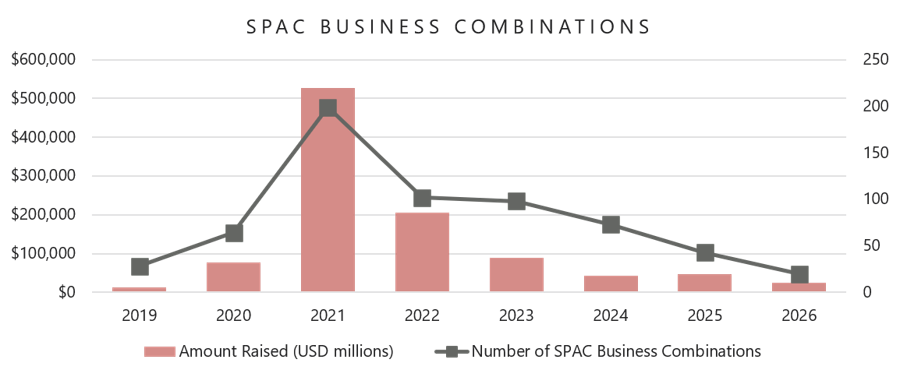
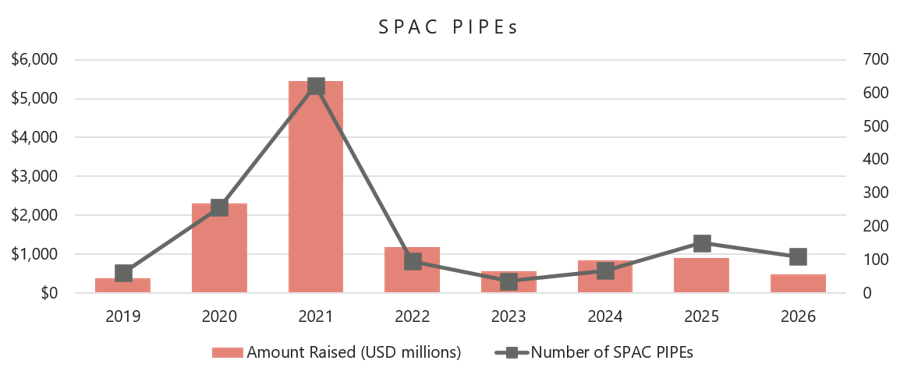
As of June 22, 2026, 20 SPAC business combinations, or “de-SPAC” transactions, closed, valued at over $25 billion. In addition, 110 de-SPAC transactions are pending. While overall activity remains below 2020-2021 peak levels, several trends indicate the SPAC market continues to evolve rather than contract and has entered a more disciplined, sustainable phase.
In 2025, 144 SPAC IPOs raised more than $30 billion and, through June 22, 112 SPACs have raised over $20 billion in 2026 with another 73 SPAC IPOs filed and pending. These statistics demonstrate continued investor interest in experienced sponsors pursuing differentiated opportunities. This trend also reflects not only growing investor appetite but also the maturation of the sponsor ecosystem. Today’s SPAC sponsors tend to be more experienced, with many launching their second or third vehicles. The regulatory landscape has also improved. SPACs are now coming to market under the framework established by the SEC’s amendments to the SPAC IPO and de-SPAC regime, which has introduced a degree of certainty that was absent during the 2021–2022 cycle. The current SEC administration has also signaled a more constructive posture toward SPACs.
Warrant coverage (i.e., the number of warrants issued to IPO investors relative to common shares sold) has remained stable over the last five quarters. In Q1 2026, the mean warrant coverage was roughly 0.24.
Underwriting fees, which are paid only if the de-SPAC transaction closes, have settled at around 3-4% for de-SPAC transactions according to a study of 495 de-SPAC transactions completed since 2021. By comparison, underwriters in traditional IPOs earn a gross spread of about 7% paid at listing.
Throughout 2023 and much of 2024, quarterly redemption rates routinely exceeded 90%, creating significant financing challenges for de-SPAC transactions. More recently, redemption rates declined to approximately 79% in the third quarter of 2025 and 68% in the fourth quarter. Although still elevated by historical standards, this trend suggests improving investor confidence.
Substantial capital remains available. As of June 22, 2026, approximately 251 SPACs were actively searching for acquisition targets, representing roughly $47 billion held in trust.
On the regulatory front, the SEC’s recent proposals on registered offering reform and enhanced filer status are encouraging for the SPAC market. If adopted in the manner in which these are proposed, the rules would allow SPACs to establish shelf registrations on a shorter timeline, enhancing the attractiveness of SPACs as a path to the public markets. Watch Anna Pinedo’s interview with Dani Burger, host of Bloomberg’s Investment Committee, for a discussion on SPACs and IPOs, with SPAC pioneer, Betsy Z. Cohen, and Periscope’s Christine McNerney, CFA.