

IPOs and Small Public Companies
As we noted in our prior post, the Office of the Advocate for Small Business Capital Formation recently issued its Staff Report for fiscal year 2025, which provides information on the Office’s activities. We discussed the Report’s findings with respect to reliance on exempt offerings as well as pooled funds. In this post, we focus on the Report’s analysis with respect to initial public offerings and small public companies. The Report provides important data that shows how our capital markets have changed in the last decade. It also raises many questions relating to whether IPOs can be made great again specifically for small companies or even for mid-cap companies.
The Report notes that the number of IPOs remains low compared to historic levels, though it is trending upward. The IPO statistics include IPOs by pooled funds, such as closed end funds, unit investment trusts, and business development companies. Taking this into account, there were 246 IPOs completed in 2024 and 180 in the first half of 2025 (these IPO statistics will be different from other reported IPO statistics, which usually exclude pooled vehicles). Excluding pooled vehicles, SPACs (yes, they’ve returned) account for the most significant amount of IPO proceeds followed by technology, real estate, manufacturing and healthcare companies.

Source: SEC OASB Staff Report
The statistics provide further confirmation of all of the reported trends of companies remaining private longer and the IPO market being hospitable largely only to more seasoned, sophisticated and well-capitalized companies. In 2024, IPOs by small companies represented 44% of all IPOs but only 3% of capital raised in IPOs. It was only IPOs by larger companies that witnessed an increase in 2024 and in the first half of 2025. In 2024, the median age of an IPO issuer increased—to 14 years! That’s an awfully long time from startup to IPO. The Report notes that from 2014 to 2024, the number of companies remaining private eight years or more after receiving their first venture capital round has quadrupled and 45% of unicorns received their first VC funding round nine or more years ago. The private secondary market is increasing in size and importance to accommodate this—the Report estimates that at June 30, 2025 the U.S. secondary market was about $61 billion. Secondaries now account for about 32% of VC exit value, so VCs are often exiting through secondaries not through IPOs as companies remain private longer. Since 2000, VC-backed companies accounted for 51% of all IPOs and 66% of technology IPOs. Founder-led IPOs were more common in high-growth sectors (services, software and life sciences) and less frequent in more traditional sectors. Of the companies that went public in 2017 through 2021 with founder CEOs, 75% remained founder-led in 2025.
This year’s Report contends that improved access to capital is an important motive for companies to go public. For larger companies, we disagree. Maybe this is the case for smaller companies and life sciences companies. The Report notes that companies that go public are likelier to have higher sales and higher capital expenditures and assets though less profitability. The Report notes that, post-IPO “on average,” public companies credit spreads dropped by almost 25%, borrowing costs declined and the pool of lenders has expanded.
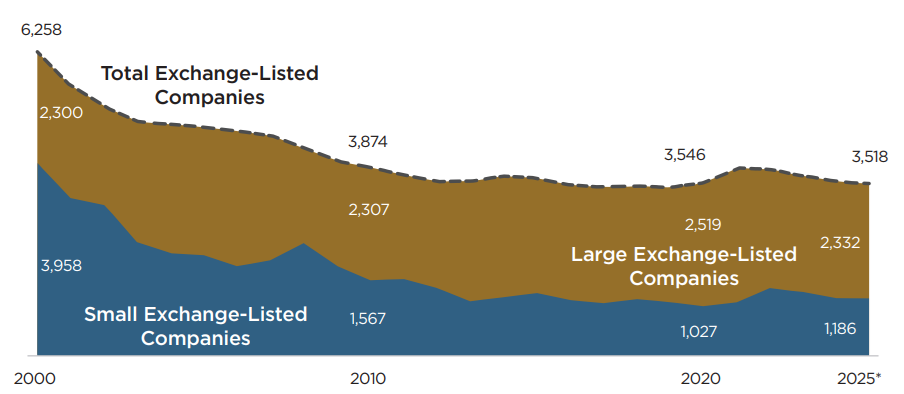
The number of exchange-listed companies continues to decline from 6,258 in 2000 to 3,518 at June 30, 2025. The most significant percentage decline has been in small exchange-listed companies, from 3,958 in 2000 to 1,186 at June 30, 2025. The Report cites a number of factors that have contributed to the decline including an increase in mergers, noting that between 1996 and 2020, there were approximately 4,000 mergers between public companies. In addition, the Report cites the low number of IPOs and the delisting of smaller companies as contributing to the decline. The Report does not cite costs or regulation. The Report does note the significant costs borne by small public companies in connection with Sarbanes-Oxley Act compliance—noting that while large companies incur higher overall costs, small public companies experience a proportionally higher cost burden. The Report quantifies the audit fees associated with the transition from non-accelerated filer status to accelerated filer status to demonstrate when these costs are particularly severe. Perhaps if the SEC reexamines filer status and “on ramps” this might mitigate the impact of these costs.
Source: SEC OASB Staff Report
The Report finds that the industries that have the most small public companies are in the healthcare sector. We should want life sciences and biotech companies to be able to access capital and to do so efficiently. The second most numerous: technology companies. The public market has fundamentally changed. Listed companies are larger—the aggregate market capitalization of listed companies increased 197% from 1996 to 2023. As we have often noted in this blog, institutional investors have moved away from the small and mid-cap market. The Report notes that many small public companies receive little or no analyst coverage. Companies included in the S&P 500 Index have an average of 20 analysts covering their stocks, while Russell Microcap Index constituent companies have an average of three analysts providing coverage. Generally, research analyst coverage is closely correlated to liquidity and impacts a company’s ability to raise capital in follow-on public offerings. Certainly, a lot of data in the Report that might inform recommendations relating to making not just going public but also remaining public as a small or midcap company attractive.